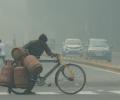
'These measures should be in place throughout the year in order to bring down AQI levels to 100 or below'

With the skies over Delhi clouded with smog, many cast worried eyes on the fate of the first India-Bangladesh Twenty20 International scheduled at the Arun Jaitley stadium on Sunday.

On Friday, for the second day in a row, residents across Mumbai woke up to unusually thick smog in the air.

Hazardous pollution has made anti-pollution gear and gadgets a near-necessity, says Khalid Anzar.

He alleged that the BJP made people burst firecrackers on Diwali.

22 of the 37 air quality monitoring stations across Delhi recorded the air quality in the severe category on Thursday morning.

Bursting firecrackers is not a matter of religion, it affects people's lives, Delhi environment minister Gopal Rai said on Wednesday and urged the Opposition not to jeopardise the well-being of children and the elderly for political ambitions.

People stood at their places with their phone cameras open but faced trouble capturing aircraft formations due to the layer of fog and smoke cloaking the capital.

Despite the national capital recording its best air quality on Diwali day in eight years, pollution levels may rise due to low night temperatures and sporadic burning of firecrackers though there is a ban on their manufacture, storage, sale and use within the city.

Delhi Chief Minister Arvind Kejriwal hopes pollution will not affect the India-Bangladesh T20 International in the city on November 3, emphasising that his government has been taking steps such as the odd-even scheme to improve the air quality.

Experts said unfavourable meteorological conditions -- calm winds and low temperatures -- and smoke from farm fires in neighbouring states led to a dense layer of haze as the air quality index entered the "severe" zone.
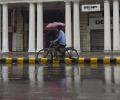
The India Meteorological Department on Wednesday issued an orange alert for Delhi, predicting 'heavy' to 'very heavy' rainfall in parts of the capital with winds gusting up to 60 kilometers per hour.

Air that people breathe in Indian cities is among the worst in the world.

The countries' biggest cities -- Delhi and Lahore -- are fighting a common enemy: Smog.

The rotation policy followed by the BCCI and the travel route for the visiting team forced the BCCI to schedule the first match of the tour in Delhi

During a hearing on Friday, the bench noted that Mumbai was witnessing a decline in the bursting of firecrackers.

The national capital stood sixth in terms of air pollution in January, with cities like Muzzaffarpur in Bihar and Varanasi showing worse air qualities.
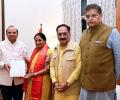
The monthly Rs 2500 payment for poor women is expected to cost Rs 11,000 crore while the pension scheme of Rs 2000 for every senior citizen will cost around Rs 4100 crore. The Yamuna clean up will cost over Rs 10,000 crore while a similar amount is required to upgrade Delhi's hospitals. Ultimately, the new BJP government will have no choice but to ask the centre for financial support, notes Rashme Sehgal.

The green body's report said three of the world's largest nitrogen oxide air pollution emission hotspots that contribute to formation of PM2.5 and ozone are in India with one in the Delhi-NCR.

According to senior IMD scientist Kuldeep Srivastava, clear sky or absence of clouds allows sun rays to reach the ground, warming up the air close to the ground which lifts up and clears the pollutants.

Doctors have declared the situation as a 'public health emergency', while the government has taken a series of measures in view of high pollution levels.

Six weather stations across Delhi recorded over 100 mm of rain in a single day, the India meteorological department (IMD) said on Thursday, categorising it as an "extremely intense spell".

Hailstorms were reported at various parts of the national capital including Palam, Chilpighat and Ayanagar, the IMD said.

Amid a spike in pollution levels in Delhi-NCR, the Supreme Court on Tuesday directed Punjab, Haryana, Uttar Pradesh and Rajasthan to ensure crop residue burning was stopped "forthwith", saying it cannot let "people die" due to pollution.

The residents of Delhi stand to lose 10 years of life expectancy if the current air pollution level persists.

According to the Graded Response Action Plan (GRAP), the air quality is considered to be in the emergency category if the PM2.5 and PM10 levels continue to be above 300 micrograms per cubic metre and 500 micrograms per cubic metre respectively for 48 hours or more.
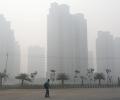
In December 2016, the Supreme Court directed the central government to have a graded action plan to tackle the menace of air pollution. There are two plans - Comprehensive Action Plan and Graded Response Action Plan.

With increasing temperature, the toxic ozone levels, which cause a number of health problems especially for asthmatics, have breached the permissible limits in the city, the MET department said on Thursday.
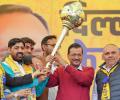
The BJP may win more seats in the February 5 assembly election, but not enough to trump AAP, notes Ramesh Menon.

IMAGES from the ICC World Cup match played between Bangladesh and Sri Lanka, in New Delhi, on Monday.

Skies over Delhi hung heavy with smoke and its air quality inched towards "severe" category on Diwali night as people burst firecrackers in a blatant disregard to the government's ban against it, imposed amid an increase in the contribution from farm fires.
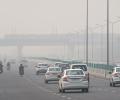
The neighbouring cities of Faridabad (469), Greater Noida (464), Ghaziabad (470), Gurgaon (472) also recorded 'severe' air pollution levels.

Pollution levels skyrocketed by the hour in Delhi on Sunday, turning the air quality hazardous, which agencies consider unfit for inhalation even by healthier people.
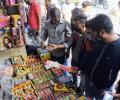
The Delhi Pollution Control Committee (DPCC) on Tuesday ordered a complete ban on the sale and bursting of firecrackers in the national capital till January 1, 2022.


In a statement, Delhi Health Minister Satyendar Jain said the air pollution had reached the severe level and asked people to follow the dos and don'ts as mentioned in the advisory.

The International Cricket Council is likely to incorporate air pollution in its 'Playing Conditions' clause, having taken a serious note of the plight of Sri Lankan cricketers during the recently-concluded Test match against India in New Delhi.
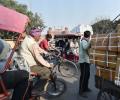
Rickshaw pullers and construction workers are the worst hit.

Has Lad offered any tips to Railways bowlers on how to dismiss Siddhesh?
The Delhi government has been following the practice of banning all kinds of firecrackers for the last three years.
